For an extended period, the relationship between China and Pakistan has been a critical component of South Asian politics, and it is frequently viewed through the perspective of their shared opposition to India. Often referred to as “higher than the Himalayas and deeper than the oceans,” this alliance is a complicated partnership founded on military, economic, strategic, and historical considerations. It goes beyond simple friendly diplomacy.
This blog examines the geopolitical, economic, military, historical, and intelligence-sharing justifications for China’s continued support of Pakistan in its conflict with India. We also examine the broader global implications of this. Understanding the complex motivations driving China’s unwavering support for Pakistan in the face of its conflict with India is the goal.
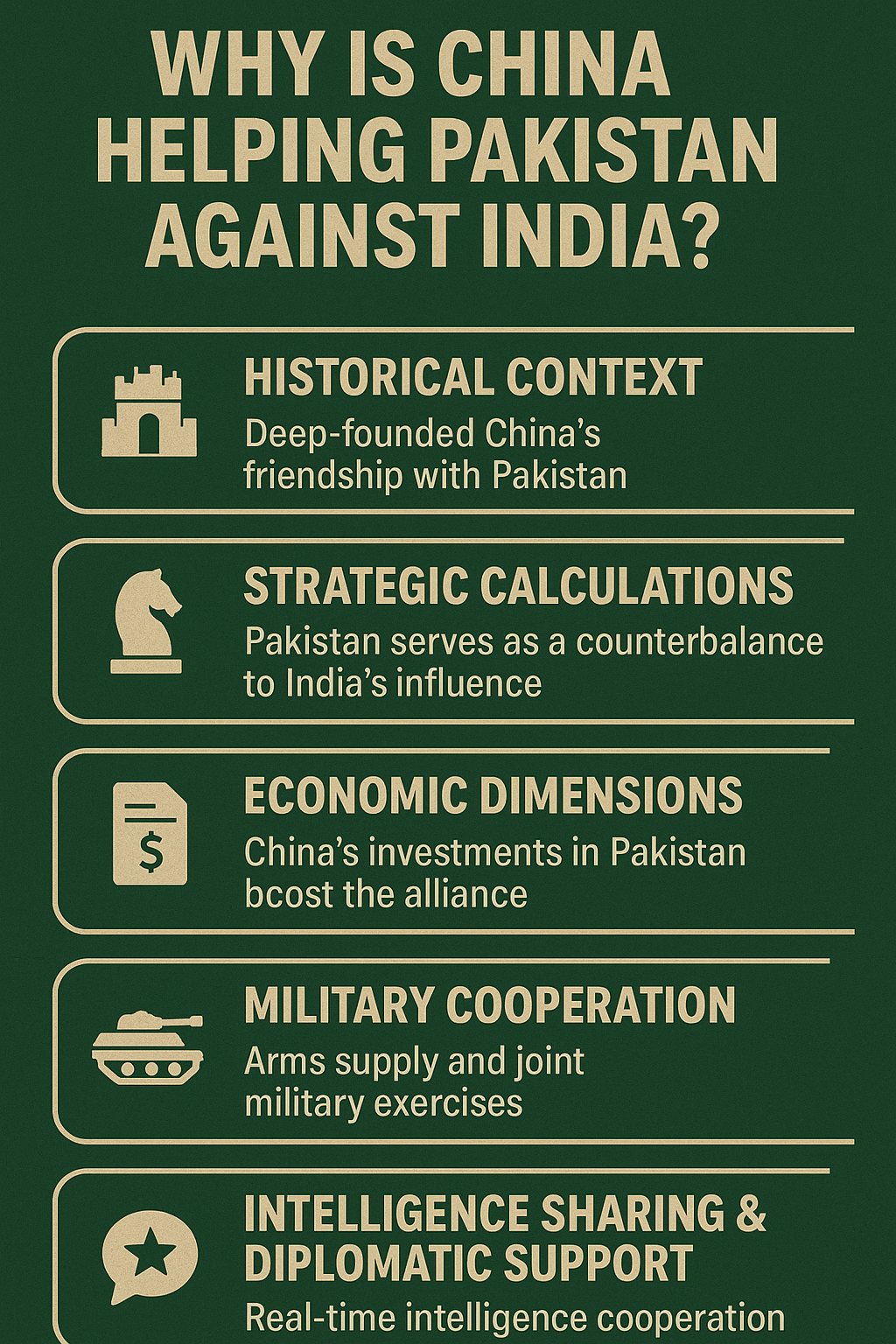
Historical Context: The Roots of China-Pakistan Friendship
China and Pakistan’s relationship intensified following the Sino-Indian War in 1962, which commenced in the early 1950s. Upon the conclusion of this conflict, China and Pakistan recognised a mutual suspicion of India that has only served to strengthen their partnership.
Beijing’s attitude toward Islamabad was substantially affected by the rivalry between China and India. Pakistan has received substantial economic assistance from China over the years, in addition to military assistance in the form of munitions, training, and defense technology transfers. China’s regional policy is significantly influenced by Pakistan’s long-standing affinity with China, which is based on shared strategic interests.
Strategic Calculations: Why Pakistan Matters to China
China sees Pakistan as a counterbalance to India’s growing might in South Asia. China sees Pakistan as an important partner in maintaining the balance of power in the region as India strengthens ties with the United States and other Western powers.
Pakistan’s location also provides China with direct access to the Arabian Sea, which is safer than the South China Sea’s potentially treacherous marine passageways. This means that Pakistan is more than just a political ally; it is also a key component of China’s regional security strategy.
Economic Dimensions: The Belt and Road Initiative and Beyond
The China-Pakistan Economic Corridor (CPEC) plays a significant role in the Belt and Road Initiative (BRI), highlighting China’s increasing engagement in Pakistan’s economic landscape. China has invested billions of dollars in infrastructure, energy, and transportation initiatives via CPEC. The aim is to transform Pakistan’s economy while safeguarding its trade routes.
The investments in the economy enhance the alliance, transforming it into something greater than mere political or military collaboration. The shared economic interests ensure that China’s support for Pakistan in its stance against India is underpinned by genuine, long-lasting commitments.
Military Cooperation: From Arms Supply to Joint Exercises
China stands as Pakistan’s foremost supplier of military hardware, equipping them with fighter jets, tanks, ships, and advanced missile systems. This military assistance enhances Pakistan’s defence capabilities and deters potential aggression from India.
Alongside hardware collaboration, the two nations engage in joint defence production and conduct regular military exercises, fostering cooperation among their armed forces. The ongoing military collaboration enhances the alliance’s strength and empowers Pakistan to effectively counterbalance India in the region.
Intelligence Sharing and Diplomatic Support: A Comprehensive Partnership
The relationship between China and Pakistan extends far beyond mere intelligence sharing. During challenging times, the ability to disseminate military and security information promptly is crucial.
China consistently supports Pakistan in various international platforms, including the United Nations Security Council and the Financial Action Task Force (FATF). It consistently opposes or resists actions that are viewed as harmful to Islamabad. This backing enhances Pakistan’s presence in global discussions, particularly regarding its disputes with India.
Geopolitical Ramifications: The China-Pakistan Alliance and Its Impact on Regional Dynamics
The relationship between China and Pakistan is closely linked to China’s border issues with India, particularly in regions such as Arunachal Pradesh and Aksai Chin. China exerts influence on India through its robust ties with Pakistan.
The alliance influences the dynamics of power and stability within South Asia. Pakistan’s stance against India is bolstered, yet this also heightens competitiveness and tensions, impacting the overall security landscape in the region.
Conclusion
China and Pakistan share a robust partnership rooted in mutual strategic objectives, economic collaboration, military alliances, and diplomatic support. Many often assume that the primary motive for the collaboration is to counter India’s influence, but the reality is far more intricate and nuanced than that. This encompasses trade pathways, local influence, and overarching strategic goals.
The partnership between China and Pakistan is likely to remain robust, even in the face of geopolitical shifts, such as India’s growing ties with the West and China’s expanding Belt and Road initiatives. China will continue to support Pakistan in its rivalry with India, driven by the interplay of historical context, strategic interests, and shared advantages in a competitive landscape.